
Last updated:
You can improve English speaking skills at home, but only by speaking. Watching films, reading and grammar exercises feed your English; they don’t train you to produce it. This guide gives you 10 techniques that make you speak, a 30-minute daily routine, and an 8-week plan, built for Pakistani learners practising at home.
Every technique below can be done alone, for free, with nothing more than your phone. The plan also shows where to add a real conversation, because that’s the one thing home practice can’t replace.
- Why Improving English Speaking at Home Is Harder Than It Looks
- What Actually Works, and What Wastes Your Time
- 10 Techniques to Improve English Speaking Skills at Home
- A 30-Minute Daily Routine
- An 8-Week Plan to Improve English Speaking Skills
- How Long Does It Take to Improve?
- Where Home Practice Runs Out
- Frequently Asked Questions
Only speaking improves speaking. Talk to yourself in English, shadow short clips, answer questions out loud and record yourself, about 30 minutes a day. Films and reading build your listening and vocabulary but don’t train you to speak. Add a real conversation with feedback when you can: it’s the one thing home practice can’t replace.
Why Improving English Speaking at Home Is Harder Than It Looks
Most home study is input: you take English in. Speaking is output: you produce it, in real time, under a little pressure. Many Pakistani learners have years of input (school, films, social media) and very little output, which is why they understand English well but freeze when it’s time to speak.
Watching English films and series, listening to podcasts, reading English books, studying grammar.
Speaking out loud, recording and reviewing yourself, repeating phrases from clear speech, answering questions aloud, having conversations.
Input still matters: it gives you the words and phrases to use. But on its own, it won’t make you a confident speaker. Every day of practice needs some output.
What Actually Works, and What Wastes Your Time
| Activity | Builds speaking? | How to make it count |
|---|---|---|
| Watching English content | Indirectly | Pause and summarise what you watched, out loud |
| Reading English | Indirectly | Read a paragraph aloud, then retell it in your own words |
| Vocabulary apps | Barely | Say each new word in a sentence about your own life |
| Talking to yourself | Yes | Two minutes a day, describing what you’re doing |
| Shadowing | Yes | Copy the rhythm and stress, not just the words |
| Recording yourself | Yes | Listen back for pauses and repeated words |
| A conversation partner | Yes, strongly | Unpredictable questions train real-time responses |
| Live classes with feedback | Yes, strongly | Corrections while you speak stop mistakes becoming habits |
The rule: if you’re not speaking, you’re not practising speaking.
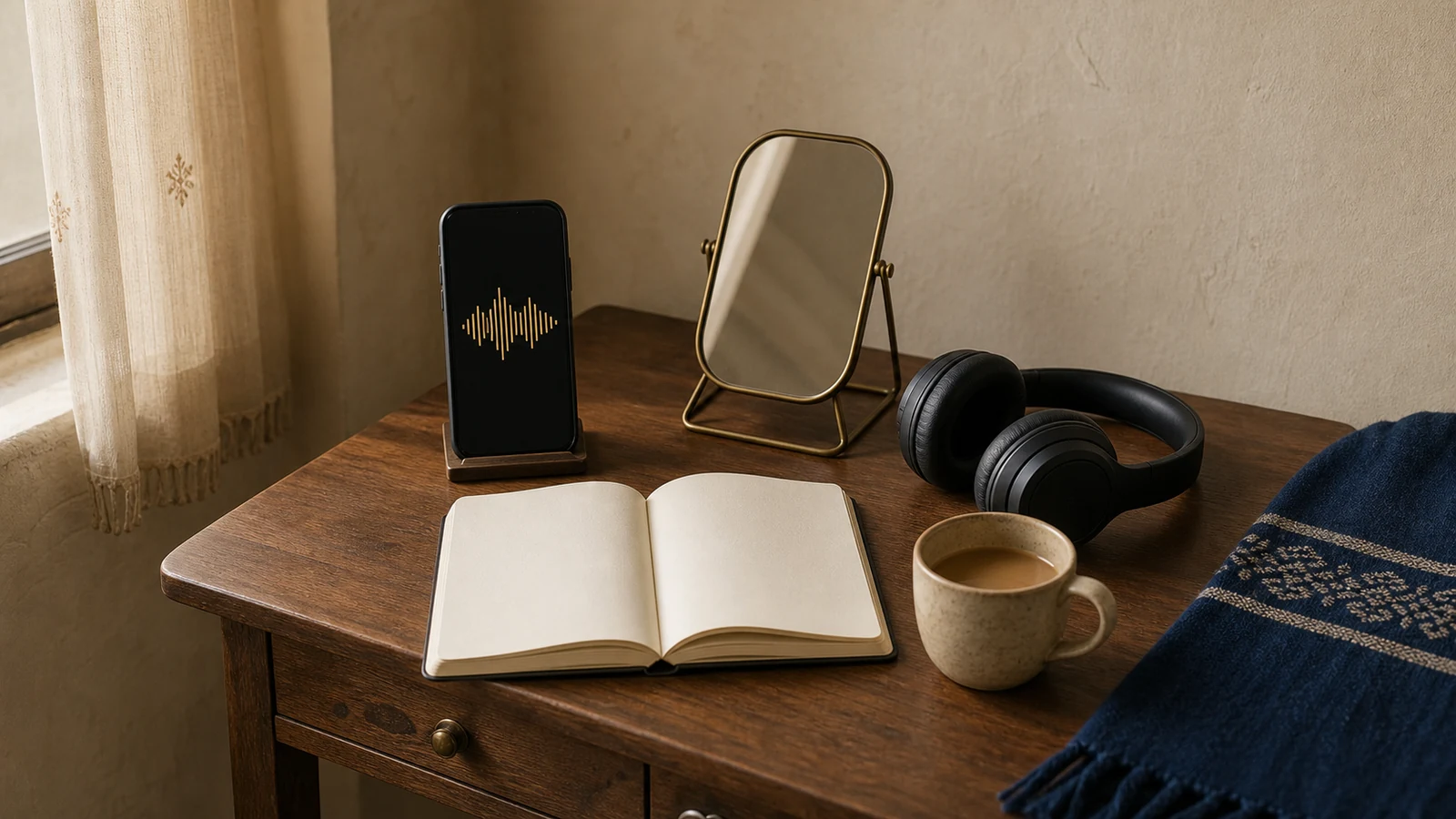
10 Techniques to Improve English Speaking Skills at Home
Describe what you’re doing as you do it (“I’m making tea, the water’s nearly boiling…”), narrate what you see from the window, or answer an imaginary interviewer. It’s the simplest way to practise finding words in real time.
Play a short clip of clear English (30–60 seconds), and repeat each sentence straight after the speaker, copying the rhythm, stress and intonation. Use the same clip for a few days before moving on.
Answer one question on your phone, then listen back. Note one thing to improve: a long pause, a repeated word, a sound that wasn’t clear. Keep your first recording, so you can hear your progress later.
Ready-made chunks such as “I was just about to…”, “That depends on…” and “What I mean is…” come out much faster than sentences built word by word. Learn three a week, and use each one out loud in a sentence about your life.
Read a short passage aloud at a comfortable pace, focusing on clear pronunciation and natural rhythm. It’s not the same as spontaneous speaking, but it warms up your mouth and builds confidence with English sounds.
Practise a self-introduction or a short answer while looking in the mirror. It helps you get used to how you look and sound while speaking English, which makes real conversations feel less strange.
After a short video or an episode, pause and explain out loud what happened, or what you thought of it. Subtitles in English help at first; summarising is where the speaking practice happens.
Choose questions you might really be asked (in an interview, at university, by a new colleague) and answer them aloud for a minute each. Don’t stop to restart; keep going and fix things next time.
A friend, a language-exchange partner or a class gives you what solo practice can’t: questions you didn’t expect. Agree on a topic, a time and English only, for 20 minutes.
While you walk or cook, describe a simple thought in English instead of translating it from Urdu. Start with familiar topics. The more often you do it, the less you’ll need to translate when you speak.
A 30-Minute Daily Routine
Thirty minutes of focused speaking a day does more than a long session once a week. Adjust the activities, but keep every part about producing English.
| Time | Activity | Technique |
|---|---|---|
| 5 minutes | Read a short passage aloud | Reading aloud |
| 5 minutes | Shadow a 30–60 second clip | Shadowing |
| 10 minutes | Talk about your day, or answer two questions aloud | Talking to yourself, answering questions |
| 5 minutes | Practise this week’s three phrases in new sentences | Phrases, not words |
| 5 minutes | Record one answer and listen back | Recording yourself |
One way to use 30 minutes. Keep the order: warm up, speak, review.
An 8-Week Plan to Improve English Speaking Skills
Do the 30-minute routine every day. Topics: introducing yourself, your family, your daily routine. Record a one-minute self-introduction on day 1, and keep it.
Stretch your answers to 1–2 minutes. Topics: your work or studies, your city, your plans. Learn three new phrases a week and use them on purpose.
Keep the routine, and add at least two conversations a week with a partner or teacher. Practise giving opinions: “I’d say…”, “It depends on…”, “On the other hand…”.
Talk for two minutes on unfamiliar topics. At the end of week 8, record the same self-introduction as on day 1, and compare the two.
How Long Does It Take to Improve?
It depends on where you start and how much you speak. With feedback, progress is usually faster than alone: in Elemental Academia’s Spoken English course, most students notice a difference within the first 2–3 weeks. At home, your recordings are the honest measure: compare week 8 with day 1.
Where Home Practice Runs Out
Home practice builds the habit of speaking, but it has two limits. You can’t predict yourself, so you never practise answering a question you didn’t expect. And you can’t hear your own repeated mistakes, because they sound normal to you. Conversation fixes the first; feedback from a teacher fixes the second. The best plan uses all three: daily home practice, regular conversation and expert correction.
Frequently Asked Questions
Live Spoken English Classes, with Feedback on Your Actual Mistakes
Elemental Academia’s live online Spoken English course is one-to-one with founder Muhammad Humza Rehan: 3 one-hour classes a week, feedback after every class and a speaking test every month, for PKR 7,500 a month at every level. Start with a free 30-minute demo class, or take the free English level test to see where you are now.
View the Spoken English course →